
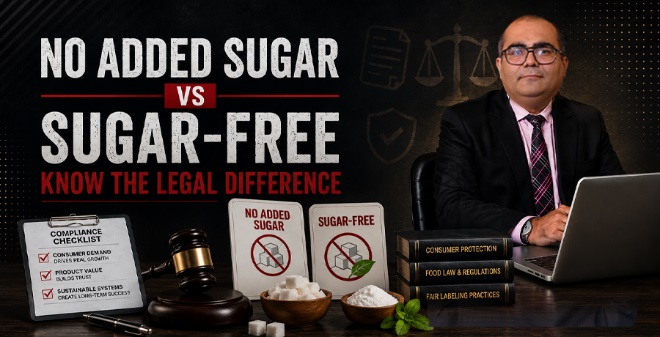
Consumers are becoming increasingly aware of their health as opposed to previous generations. Food brands have capitalized on this health awareness by using claims for their products, such as "No Added Sugar," "Sugar-Free," "Low Sugar," "Natural Sweetener," and "Sweetened with Dates," as a marketing tool.
Despite these apparently straightforward claims, they are actually heavily regulated under Indian food law. Therefore, even though consumers may see an attractive claim from a marketing angle, if there is no basis for the claim in regulation, the brand may face regulatory scrutiny, notices, or enforcement action.
In recent months, discussions around sugar-related claims have brought renewed attention to the importance of accurate food labeling and transparent consumer communication. This serves as an important reminder for food businesses to review their packaging, advertisements, and product claims carefully.
Sugar Claims Must Be Paid Attention
Many consumers view products labeled with terms such as 'No Added Sugar' or 'Sweetened Naturally' as healthier options. In contrast, the basis for an authority's evaluation of the claims these products make relates to the definition of those terms and the actual parameters of the law as opposed to how a consumer perceives them.
The problems that arise are that businesses use products, including but not limited to:
- Date Syrup
- Date Paste
- Honey
- Jaggery
- Fruit Concentrate
- Other Sweetening Agents
To create a product that makes a claim on the label but does not consider how these products may or may not support the claim's validity.
For many businesses, the primary focus when developing a product relates to the marketing message, and they do not consider the regulatory interpretation of the claim.
Common Sugar Claims Explained
- Sugar-Free: A product can be marketed as “sugar-free” if it meets the sugar content thresholds set out in the Food Safety and Standards (Labelling and Display) Regulations, 2020; simply removing or replacing the sugar with a sweetener does not make it “sugar-free.”
- Low Sugar: A product can only use a “low sugar” claim if it meets some specific low sugar threshold guidelines set out in the Food Safety and Standards (Labelling and Display) Regulations, 2020, which can be verified through a nutritional analysis and documentation.
- No Added Sugar: This claim typically means there were no sugars or sweeteners added during the manufacturing process; however, this may not be true if the product contains naturally occurring sugar in the ingredient list.
- Naturally Occurring Sugars: Many food products contain sugars that are naturally occurring in fruits, milk, grains, etc. The existence of these naturally occurring sugars is not to be confused with the absence of all sugars.
Common Errors with Food Safety Regulations Committed by Businesses in the Food Industry.
- Mistake 1: Treating Marketing as Regulation
Many companies believe they can use reasonable claims based on consumer perceptions; however, regulators may have a different opinion. -
Mistake 2: Only Looking at the Front of the Label
Claims on the front of a product are subject to increased scrutiny by regulatory authorities. Every claim on the front of a product should be reviewed for compliance with regulations. -
Mistake 3: Failing to Interpret Ingredient Functions
Understanding the intended function and composition of ingredients included in formulations will greatly aid businesses in determining if their claims are compliant. -
Mistake 4: Inconsistently Representing Claims Across All Media
A claim made on a product's label should be used consistently in the following areas:
- Website
- Social media
- Product Brochures
- Advertising
- Distributor Communications
Misleading sugar claims can have serious consequences for a store's business operations. Businesses that fail to comply with the applicable regulations may face regulatory notices, complaints from customers about the claims, costs associated with relabeling products, modifications to advertising, damage to brand reputation, and increased scrutiny from regulators.
Additionally, if a business has to correct the labels on its products after they have already been released to the market, the costs incurred to make those corrections may significantly exceed the costs incurred if the business had conducted a compliance review prior to launching the product.
Before making claims about sugars on their labels, food businesses should take the following steps:
- Review all claims made on the front of the packaging
- Verify that the claims are allowed by regulation
- Ensure that accurate testing has verified the nutritional value of the product
- Review all marketing content for consistency
- Conduct a legal and regulatory compliance review
Taking a preventive approach to compliance is always less expensive than responding to regulatory inquiries after the fact.
Conclusion
Labels on food products used to be just a branding tool, but now they have become a representation of what food manufacturers state their food to be or to have. With more scrutiny on food manufacturers and their food claims, they need to ensure that any claims on the food label are accurate, substantiated, and compliant with applicable laws.
The difference between a successful product launch and a very expensive compliance problem could be just one statement on the food label.
Before food manufacturers use terms like “No Added Sugar,” “Sugar-Free,” or “Lower in Sugar,” they should conduct a complete regulatory review to ensure that their labeling reflects the information transparently and in a legally compliant manner.
How Piplbyte Can Support You
Piplbyte offers food manufacturers the following:
- Product Label Compliance Review
- FSSAI Regulatory Compliance
- Advertising & Marketing Claims Review
- Packaging Compliance Audit
- Product Launch Compliance Support
- Regulatory Risk Assessment
If you are launching a new food product or just want to review your existing food labels, our compliance experts will help make sure your claims are compliant with regulatory guidelines before they are available to consumers.